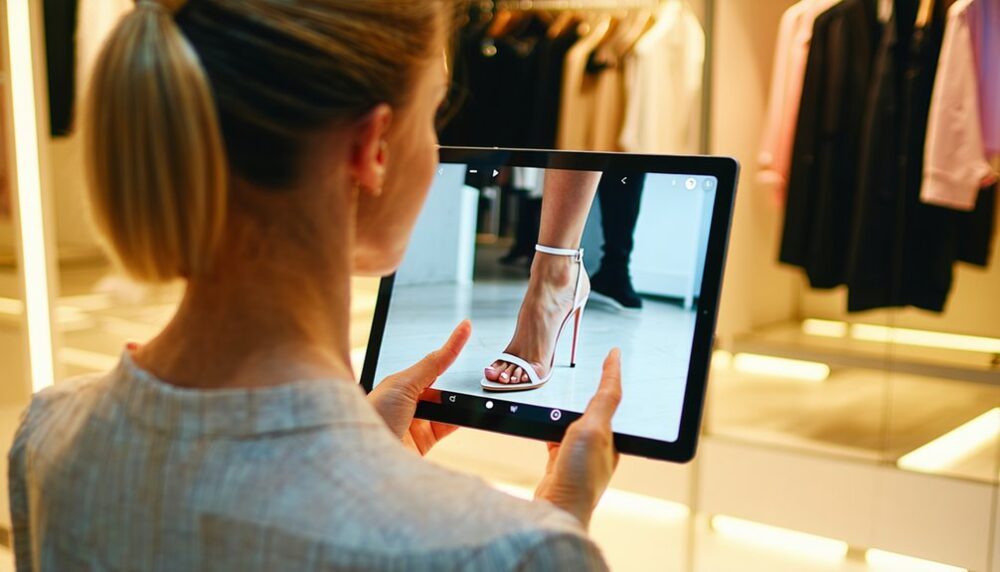
Augmented reality enhances online shopping by providing immersive experiences. It enables true-scale product visualisation and virtual try-ons, enhancing purchase confidence. AR reduces friction in the shopping process, increasing conversion rates. Its benefits are apparent, with 73% consumer satisfaction reported. As ecommerce continues to evolve, augmented reality plays a key role, and exploring its applications reveals a deeper understanding of its revolutionary potential.
How Augmented Reality Enhances Online Shopping
Augmented reality improves online shopping by reducing uncertainty and increasing engagement. It helps sustain logistics by decreasing returns, which is linked to better product visualization. Consumers benefit from increased confidence in their purchases, with studies showing that AR technology can lead to higher satisfaction rates, such as the 73% satisfaction rate reported by consumers who used AR while shopping in 2020. Retailers must consider AR ethics to guarantee a positive experience. The use of 3D visualisations has been shown to boost purchase confidence and satisfaction, leading to a more enjoyable online shopping experience. By leveraging virtual try-ons, retailers can further enhance the online shopping experience and increase customer satisfaction.
What Is Augmented Reality In Ecommerce
Many ecommerce platforms are now incorporating augmented reality, a technology that overlays digital content onto the real world, often through a smartphone camera or browser-based view. This blend of digital and physical environments enhances online shopping. The use of augmented reality can also increase customer satisfaction by providing interactive experiences that allow customers to visualize products in their own environment. With the rise of ecommerce, the use of markerless technology is becoming increasingly popular, enabling customers to try out products virtually without the need for physical markers.
As AR becomes more prevalent, considerations around AR ethics and responsible use emerge. The use of AR analytics helps track engagement and effectiveness, informing future implementations. With the expectation of 71% of consumers to shop more frequently if AR were available, the inclusion of AR technology is becoming a key factor in ecommerce development.
Benefits Of Ar For Product Visualization
Augmented reality is revolutionizing the way products are visualized online, enabling shoppers to interact with digital representations of items in their physical environment.
This technology provides a more accurate understanding of product scale and fit, reducing guesswork and post-purchase surprises.
AR analytics and conversion metrics demonstrate its effectiveness, with a 200% increase in engagement and 64% higher purchase intent.
By enhancing product visualization, AR improves customer understanding and interaction, ultimately driving sales and reducing returns.
With AR, online shopping becomes more immersive and personalized, leading to a more satisfying experience for customers.
The use of virtual try-ons and other interactive features has become a key component of many online shopping platforms, allowing customers to make more informed purchasing decisions.
The integration of AR technology has also led to significant reductions in product returns, with some brands reporting cost savings due to improved customer satisfaction and more informed purchasing decisions.
Companies that utilize 3D tools can see a significant increase in purchase intent, with some experiencing up to 64% higher intent, which can lead to increased sales and revenue.
How Ar Improves Purchase Confidence
As shoppers explore online stores, their purchase confidence is substantially strengthened by the integration of augmented reality, which effectively reduces uncertainty and ambiguity surrounding product appearance, fit, and suitability.
Augmented reality provides a confidence boost by enabling visual reliability and decision certainty. This technology cultivates trust in the product, allowing shoppers to make more informed decisions.
With augmented reality, shoppers experience a significant increase in confidence, leading to a more positive online shopping experience. By reducing uncertainty, augmented reality enhances purchase confidence, ultimately strengthening trust and decision certainty. This leads to a more confident and satisfied shopper.
The use of Virtual Try-On has been particularly effective in enhancing purchase confidence, as it allows shoppers to see how products would look on them before making a purchase, thereby increasing their confidence in their buying decisions.
The implementation of Spatial Analysis has also played a crucial role in improving the overall online shopping experience, as it enables a more accurate representation of products in the shopper’s environment.
Studies have shown that the inclusion of AR features in online shopping platforms can significantly impact consumer behavior, leading to increased purchase intent and customer engagement, which is a key finding from the research on the impact of augmented reality within the fashion industry.
Reducing Friction In The Shopping Process
How effectively can online shopping experiences be streamlined to minimize friction and maximize conversion rates?
Augmented reality (AR) plays a significant role in friction reduction by providing true-scale visualization and product-in-room previews. This enables shoppers to assess products in a realistic setting, reducing uncertainty and ambiguity.
As a result, AR facilitates autonomous checkout, allowing shoppers to make more informed decisions and complete purchases more efficiently. By utilizing 3D models, online retailers can further enhance the shopping experience, increasing customer confidence and driving sales. The implementation of AR technology has been shown to increase conversion rates by 20-30%, making it a valuable tool for online retailers.
The use of WebAR has also been shown to improve customer engagement, with many shoppers reporting a more immersive and interactive experience, which can lead to higher sales and lower return rates.
Enhancing Engagement With Immersive Experiences
Enhancing engagement is essential for driving commerce performance, and immersive experiences play a key role in this effort.
Immersive gamification and sensory storytelling enable shoppers to interact with products in a more engaging and memorable way.
Through augmented reality, customers can experience products in 3D, real-time views, strengthening immersion and reducing uncertainty.
This interactive engagement encourages deeper product exploration, increasing time and attention spent with items.
As a result, immersive experiences contribute to higher customer trust, stronger purchase intention, and increased satisfaction, ultimately driving commerce performance and nurturing a sense of belonging among shoppers.
The Role Of Ar In Fashion And Beauty
Immersive experiences have been shown to drive commerce performance, and the fashion and beauty industries are no exception.
AR fashion trends are enhancing online shopping, with major brands leveraging AR for product visualization.
Beauty brand storytelling is also being redefined through AR, enabling customers to interact with products in a more engaging way.
AR supports exploration of clothing, shoes, and accessories, as well as beauty products, through smartphone cameras and digital overlays.
This technology is shifting the way consumers shop, making it more vibrant and shareable, and supporting viral marketing on social platforms with interactive storytelling.
Using Ar For Virtual Try-Ons And Fittings
Virtual try-ons are revolutionizing the online shopping experience, allowing consumers to visualize products on themselves before making a purchase. This technology uses augmented reality, improving fit and style visualization, and reducing uncertainty about appearance.
With AI driven sizing, consumers can guarantee a perfect fit, saving time and respecting their privacy.
Fitting is also made easier, allowing shoppers to compare styles and sizes virtually, increasing purchase confidence and reducing returns.
Creating Personalized Shopping Experiences
Numerous retailers are leveraging augmented reality to create personalized shopping experiences that cater to individual preferences and needs. They employ privacy driven profiling to understand customer behavior, enabling contextual styling that connects with shoppers.
By combining digital content with physical surroundings, retailers provide customized product suggestions, increasing engagement and satisfaction. This approach allows customers to feel more connected to the brand, encouraging a sense of belonging.
As a result, retailers can build stronger relationships with consumers, driving loyalty and retention through personalized and immersive experiences. Contextual styling enhances the shopping experience.
How Ar Supports Better Product Decision Making
Retailers’ efforts to create personalized shopping experiences have yielded significant benefits, including increased customer engagement and satisfaction.
Augmented reality (AR) enhances online shopping by supporting better product decision making.
AR provides decisionive analytics, enabling shoppers to make informed choices.
It also promotes shopper autonomy by offering immersive previews and virtual try-on tools.
This allows customers to assess products in a real-world setting, reducing uncertainty and purchase anxiety.
By supplying richer product information, AR strengthens product understanding and supports more confident purchase judgments, ultimately leading to increased satisfaction and engagement.
AR enables shoppers to make informed decisions.
The Business Impact Of Augmented Reality
The integration of augmented reality (AR) into ecommerce platforms has a deep impact on business operations, yielding significant benefits that extend beyond enhanced customer experiences.
AR integration can lead to a substantial AR ROI, driven by higher conversion rates and reduced product return rates.
Effective supply-chain integration is also essential, as it enables seamless execution of AR-powered experiences.
By streamlining operations and improving customer satisfaction, businesses can gain a competitive edge.
With AR, companies can increase average order size, reduce order cancellations, and lower reverse-logistics costs, ultimately driving revenue growth and improving their bottom line.
Growing Demand For Ar In Ecommerce
How quickly is the demand for augmented reality in ecommerce growing, and what factors are driving this trend?
The AR market forecasts indicate a 30.8% CAGR from 2020 to 2025. Consumer adoption trends show a strong preference for AR-enabled shopping, with 71% of shoppers preferring retailers offering AR capabilities. As a result, AR in ecommerce is becoming a necessity, driven by consumer demand for personalized and interactive experiences. AR market forecasts and consumer adoption trends suggest a significant growth in the AR market, with rising demand for immersive shopping experiences.
Implementing Ar In Your Online Store
Demand for augmented reality in ecommerce is driving businesses to integrate this technology into their online stores.
To successfully implement AR, companies should prioritize customer onboarding, ensuring a seamless user experience. This involves creating high-quality 3D models and integrating them into the ecommerce platform.
AR analytics can help track customer engagement and inform future improvements.
By focusing on these key areas, businesses can create an immersive and interactive shopping environment that enhances customer confidence and clarity, ultimately driving sales and loyalty.
Effective implementation of AR can be a key differentiator for online stores.
Overcoming Challenges In Ar Adoption
Companies integrating augmented reality into their ecommerce platforms face numerous challenges that can hinder successful adoption.
To overcome these challenges, it is essential to address consumer concerns, such as privacy adoption.
Implementing strong privacy safeguards is essential to build trust and confidence among users.
By prioritizing transparency and security, businesses can mitigate adoption risk and encourage seamless integration of AR technology.
Effective implementation of privacy safeguards can facilitate widespread adoption, ultimately enhancing the online shopping experience.
The Future Of Augmented Reality In Online Shopping
Augmented reality is prepared to revolutionize the online shopping experience, shifting the model from static images to immersive, interactive environments.
The future of AR in online shopping will focus on enhancing customer experience through immersive product visualization and virtual try-ons.
As AR adoption grows, it will also incorporate sustainable logistics and AR driven analytics to optimize the shopping process.
This will lead to higher confidence and conversion rates, making online shopping more engaging and personalized.
With AR, online shopping will become more seamless, convenient, and enjoyable, ultimately changing the way people shop online.
Frequently Asked Questions
Is AR Compatible With All Devices?
No, AR is not compatible with all devices, requiring specific device compatibility and cross‑platform support for optimal performance across various devices.
How Secure Is AR Technology?
They prioritize privacy, leveraging data encryption to safeguard user information, ensuring secure AR experiences.
Can AR Be Used Offline?
Yes, offline AR is possible, ensuring data privacy while utilizing offline capabilities for enhanced user experiences.
Is AR Only for Large Businesses?
No, AR is not exclusive to large businesses, as small adoption and scalability are feasible, with AR ROI assessment revealing benefits for companies of all sizes, promoting inclusive growth.
How Much Does AR Cost?
They estimate AR costs vary, considering budget pricing and ROI estimation, with basic apps starting at $2,600 and complex versions exceeding $300,000, impacting overall investment and potential returns considerably.
References
- https://blog.emb.global/augmented-reality-in-online-shopping/
- https://sitetuners.com/blog/augmented-reality-in-e-commerce-revolutionizing-online-shopping-and-cro/
- https://rezolve.com/blogs/augmented-reality-ar-and-virtual-reality-vr-in-ecommerce/
- https://councils.forbes.com/blog/augmented-reality-in-retail
- https://www.bigcommerce.com/articles/ecommerce/ecommerce-augmented-reality/
- https://www.vividworks.com/blog/augmented-reality-ecommerce-examples
- https://www.salsify.com/blog/augmented-reality-in-retail
- https://www.linkedin.com/top-content/ecommerce/using-augmented-reality-in-online-shopping/augmented-reality-features-that-improve-online-shopping/
- https://www.reddit.com/r/augmentedreality/comments/1bvm3u7/ar_for_retail/
- https://www.sciencedirect.com/science/article/pii/S2772503024000380