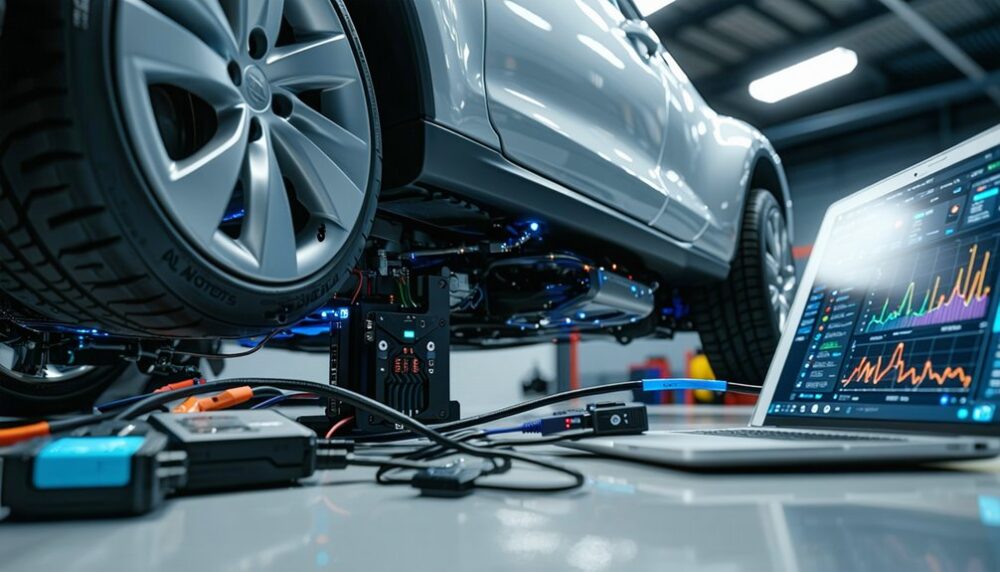
Connected cars employ real-time diagnostics and predictive analytics to improve vehicle maintenance. Telematics systems enable remote monitoring, reducing breakdown risk and lowering costs. Predictive maintenance strategies allow for proactive upkeep, maximizing vehicle performance. As technology continues to advance, connected cars are positioned to revolutionize the maintenance environment, and exploring their capabilities reveals a future of enhanced efficiency and safety.
What Are Connected Cars And How Do They Work
Approximately seventy percent of new vehicles are now connected cars, which are defined as vehicles that can communicate bidirectionally with external systems outside the car.
Connected cars rely on embedded telematics and cellular modems, collecting data on vehicle performance and driver behavior. This raises concerns about data privacy and regulatory compliance.
As the use of connected cars grows, ensuring the security and responsible handling of collected data is vital. Connected cars must adhere to regulatory compliance standards to protect user data and maintain trust in the technology. The development of connected cars is also influenced by the goal of reducing crashes and improving road safety, which is a key aspect of the transportation industry.
The evolution of connected cars has been influenced by key milestones, including the introduction of OnStar in 1996, which pioneered safety-focused connected services and paved the way for modern vehicle maintenance and management capabilities. With the integration of V2X communication, connected cars can now share real-time safety data with other vehicles and infrastructure, further enhancing road safety.
This balance is essential for the widespread adoption of connected cars.
Benefits Of Real-Time Diagnostics In Vehicle Maintenance
Many vehicle owners and fleet managers are leveraging real-time diagnostics to streamline their maintenance operations, and the benefits are numerous. Real-time diagnostics provide instant fault alerts, enabling swift identification of issues. Sensor fusion insights offer a thorough understanding of vehicle health, allowing for data-driven decisions. This approach facilitates faster fault detection, reducing downtime and repair costs. The use of telematics systems has become increasingly popular in the industry, as it enables the collection and transmission of vehicle data in real-time, supporting advanced maintenance strategies. By monitoring real-time data from various vehicle sensors, owners can gain valuable insights into their vehicle’s condition, enabling proactive maintenance and minimizing potential issues. By utilizing remote diagnostics, fleet managers can reduce downtime by up to 30% and improve overall fleet reliability metrics.
How Predictive Maintenance Reduces Breakdown Risk
As vehicle owners and fleet managers continue to seek innovative solutions to minimize downtime and optimize maintenance operations, predictive maintenance has emerged as a pivotal strategy in reducing breakdown risk.
By leveraging real-time sensor data and advanced algorithms, predictive maintenance enables early detection of potential failures, allowing for proactive repairs and minimizing unplanned downtime.
This approach also yields significant cost savings by reducing emergency repairs.
Moreover, high sensor reliability is essential for accurate predictions, enabling timely interventions that prevent breakdowns and promote overall vehicle health, ultimately leading to substantial cost savings.
The implementation of predictive maintenance is particularly valuable for high-volume or continuous operations with significant cost or safety risks, and it utilizes real-time data to forecast component failure, which is a key aspect of its effectiveness.
Predictive maintenance is made possible by the use of predictive analytics, which helps to identify potential issues before they become major problems, and this is a crucial factor in the success of modern vehicle maintenance strategies.
The use of advanced analytics tools is critical to the success of predictive maintenance, as it enables the analysis of complex data sets and the identification of patterns that may indicate potential failures.
The Role Of Telematics In Remote Vehicle Monitoring
Vehicle owners and fleet managers are increasingly relying on telematics to enhance their maintenance operations, building on the foundation of predictive maintenance that has proven effective in reducing breakdown risk.
Telematics systems collect vehicle data, enabling remote monitoring of engine and system health. To guarantee telemetry data privacy, integration platform standards must be adhered to. This allows for secure data transmission and analysis, facilitating proactive maintenance decisions.
The use of real-time diagnostics enables vehicle owners to address potential issues before they become major problems, reducing downtime and improving overall vehicle reliability.
By utilizing GPS tracking, fleet managers can also monitor vehicle location and movement, which can help identify potential maintenance issues before they occur, and schedule maintenance accordingly.
The ability to monitor vehicle emissions also plays a crucial role in maintaining a vehicle’s overall health and ensuring regulatory compliance.
Improving Fleet Uptime With Data-Driven Maintenance
Data-driven maintenance is revolutionizing the way fleets approach upkeep, shifting the framework from reactive to proactive by leveraging real-time vehicle data to identify potential issues before they escalate into major failures.
Predictive analytics enables fleets to anticipate and address problems before they occur, reducing downtime and increasing overall efficiency.
AI driven scheduling optimizes maintenance planning, allowing for more effective use of resources and minimizing disruptions.
The implementation of predictive maintenance has been shown to reduce unplanned downtime by 45%, which can lead to significant cost savings and improved fleet productivity.
By utilizing telematics devices, fleets can collect valuable data on vehicle performance, enabling them to make informed decisions and improve overall maintenance strategies.
The use of real-time data integration enables fleets to process over 300 million messages daily, providing instant notifications of potential issues and allowing for swift action to be taken.
How Remote Diagnostics Speed Up Service Decisions
Fleets that have adopted proactive maintenance strategies are now leveraging remote diagnostics to further optimize their service decisions. Remote diagnostics provide real-time fault data, enabling faster issue identification and reducing delays. This approach guarantees data security and protects user privacy.
The Advantages Of Over-The-Air Software Updates
Embracing the potential of over-the-air software updates revolutionizes the way manufacturers and owners approach vehicle maintenance, enabling them to stay ahead of the curve regarding technology and performance.
This approach enhances software security and allows for firmware optimization, ensuring vehicles remain up-to-date and secure.
With the ability to remotely update software, manufacturers can quickly address issues and improve overall vehicle performance.
This leads to reduced service visits and faster bug fixes, ultimately improving the overall driving experience.
Streamlining Fleet Maintenance Management Processes
How can vehicle owners and managers optimize their maintenance operations to minimize downtime and maximize efficiency? They can utilize fleet analytics to streamline processes and inform maintenance budgeting decisions.
By utilizing data-driven understanding, owners can identify areas for improvement and allocate resources effectively. This enables proactive maintenance, reducing unscheduled downtime and extending vehicle lifespan.
Effective fleet maintenance management is essential for belonging to a community that values reliability and efficiency. By adopting a data-driven approach, owners can optimize their operations and stay ahead of the curve. This leads to better decision-making and improved overall performance.
Enhancing Driver Convenience With Maintenance Alerts
Vehicle owners and managers who optimize their maintenance operations to minimize downtime and maximize efficiency can now take advantage of another key benefit: enhanced driver convenience.
Connected cars provide real-time maintenance alerts, allowing for convenient scheduling and reducing guesswork.
Alert customization enables drivers to receive personalized notifications, streamlining the maintenance experience.
With mobile app notifications, drivers can access vehicle status and schedule maintenance promptly, supporting routine upkeep and reducing reliance on memory.
This leads to faster response times and improved vehicle health, making maintenance more efficient and convenient for drivers.
The Future Of Vehicle Maintenance: Trends And Innovations
The scenery of vehicle maintenance is undergoing a significant change, driven by advancements in technology and shifting market demands. AI driven diagnostics is emerging as a key trend, enabling predictive maintenance and reducing reactive repairs.
Robotics automation is also streamlining maintenance workflows, shifting technicians toward complex repairs. This shift is expected to improve efficiency and reduce downtime.
With connected vehicles and advanced onboard technologies, the future of vehicle maintenance is becoming more proactive and less disruptive. As a result, vehicle owners can expect improved uptime and reduced maintenance costs, making vehicle ownership more convenient and cost-effective.
Understanding Vehicle Health Through Connected Car Systems
Advances in connected car systems are revolutionizing the way drivers and fleet managers understand vehicle health. Connected cars collect real-time data from onboard sensors, utilizing sensor fusion to monitor engine, transmission, and battery health.
Battery health analytics provide useful perspectives into vehicle performance, enabling proactive maintenance decisions. By combining telecommunication and informatics, telematics supports live health tracking and remote analysis, giving users a broader view of vehicle status.
This integrated approach enhances visibility into component condition, allowing for more informed maintenance decisions and improved vehicle upkeep. Connected car systems are streamlining vehicle health monitoring.
Reducing Repair Costs With Proactive Maintenance Strategies
How effectively can proactive maintenance strategies reduce repair costs for connected cars? Proactive maintenance enables cost savings by detecting issues before they escalate, reducing unplanned downtime and reactive repairs. Connected car systems facilitate early fault detection, allowing for timely interventions and minimizing secondary damage.
This approach can lead to warranty extension and reduced maintenance costs over the vehicle’s lifecycle. By prioritizing repairs based on actual condition and usage, owners can avoid unnecessary shop visits and over-maintenance, resulting in significant cost savings and improved overall efficiency. This leads to increased cost savings and potential warranty extension.
The Impact Of Connected Cars On Road Safety And Efficiency
Connected cars are revolutionizing road safety and efficiency by leveraging state-of-the-art technologies to prevent accidents, reduce congestion, and minimize travel times.
They employ safety analytics to detect potential threats and take action.
Traffic optimization is also improved through connected vehicles, which can share speed and location data to move traffic more smoothly.
This enables smarter traffic management, reducing congestion and travel times.
By leveraging these technologies, connected cars can markedly enhance road safety and efficiency, creating a better driving experience for all.
Safety analytics and traffic optimization are key to achieving these benefits.
How Connected Car Technology Supports Personalized Maintenance
Several key technologies underpin the personalized maintenance experience offered by connected cars, enabling a more customized approach to vehicle care.
Connected cars gather custom data, creating detailed driver profiles that inform maintenance decisions.
This data is used to provide *customized* recommendations, ensuring vehicles receive the right service at the right time.
By analyzing driver profiles and vehicle condition, connected cars can predict maintenance needs, reducing the risk of breakdowns and improving overall ownership experience.
This personalized approach to maintenance helps build trust and loyalty between drivers and their vehicles, *nurturing* a sense of belonging and satisfaction.
Maximizing Vehicle Performance With Connected Car Solutions
Vehicle performance optimization is essential for a seamless driving experience, and advancements in connected car technology have made it possible to maximize performance while minimizing downtime.
Connected cars employ AI driven diagnostics and sensor fusion to detect issues before they escalate.
Real-time diagnostics and predictive maintenance enable proactive maintenance scheduling, reducing unplanned downtime.
This optimized approach guarantees vehicles operate at peak performance, providing a better driving experience.
By leveraging connected car solutions, drivers can enjoy improved reliability and efficiency, resulting in increased overall satisfaction.
Connected cars are revolutionizing vehicle maintenance.
Frequently Asked Questions
What Is Vehicle Data Storage?
Vehicle data storage employs cloud analytics, data compression, and storage redundancy to minimize latency monitoring, ensuring efficient and reliable data management for connected vehicles.
Can Updates Fix Hardware Issues?
No, software and firmware updates cannot fix hardware issues, but remote diagnostics can help identify problems, guiding repairs and minimizing shop visits.
How Secure Is Connected Car Data?
Connected car data security is a concern, as resilient encryption standards are essential to protect data privacy, but varying standards and implementation gaps pose significant risks to sensitive information.
Do Connected Cars Increase Costs?
Connected cars can increase costs, but they also enable cost savings and enhance service efficiency through predictive maintenance and data-driven understand, ultimately optimizing vehicle performance.
Are All Cars Compatible?
No, all cars are not compatible, due to varying hardware compatibility and inconsistent firmware standards across vehicles, limiting connected features and functionality.
References
- https://www.youtube.com/watch?v=RjJqQSJoJJA
- https://www.aeris.com/resources/connected-vehicles-explained-how-modern-cars-really-communicate/
- https://www.sunsethillssubaru.com/blogs/4580/understanding-the-connected-car-system-a-comprehensive-guide/
- https://www.dealerware.com/articles/connected-car-how-it-can-benefit-your-service-department/
- https://smartcar.com/blog/connected-car-technology
- https://www.endava.com/glossary/connected-cars
- https://www.autosinnovate.org/initiatives/innovation/connected-vehicles
- https://www.transportation.gov/research-and-technology/how-connected-vehicles-work
- https://www.youtube.com/watch?v=1okYLlwsH3w
- https://connectedcars.io