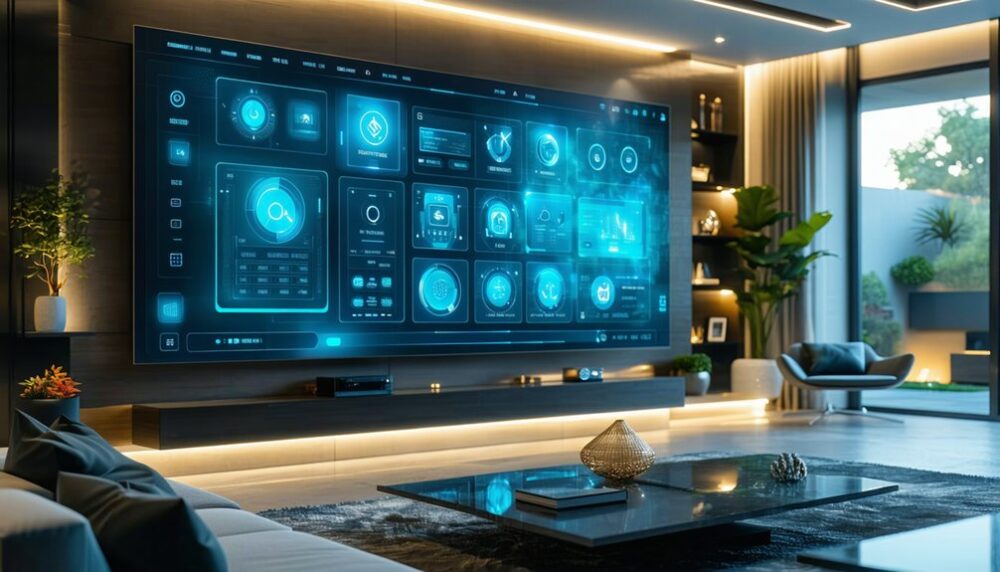
Smart homes are becoming more intelligent through AI integration and interoperability standards. They enable seamless control and enhanced energy efficiency. Interoperability unifies ecosystems, while the Matter standard guarantees secure device communication. As technology advances, smart homes will continue to evolve, incorporating emerging innovations that will further reshape the way people live and interact with their homes, and there is more to uncover about the future of smart home intelligence.
What Is A Smart Home And How Does It Work
Many residences are now being equipped with internet-connected devices that automate tasks and can be controlled remotely, giving rise to the concept of a smart home.
This technology raises concerns about privacy and data sovereignty, as sensitive information is shared across devices.
A smart home typically requires a network connection, smart devices, and a control system or app.
With interconnected devices, residents can enjoy convenience and efficiency, but must also prioritize protecting their personal data to maintain privacy.
The central component of a smart home is often a hub that connects and controls all the devices, making it a crucial part of the smart home ecosystem.
The incorporation of smart devices in homes has led to increased energy efficiency, with some homes achieving a reduction in whole-house usage of 10-20%.
Benefits Of Smart Home Automation For Homeowners
Smart home automation is reforming the way homeowners interact with their living spaces, offering a wide range of benefits that enhance convenience, energy efficiency, and overall quality of life.
It promotes lifestyle integration, allowing for seamless control and health monitoring.
By reducing energy consumption, smart homes can lower privacy cost and minimize data privacy concerns.
With automated systems, homeowners can enjoy a more comfortable and secure living experience, while also benefiting from potential long-term cost efficiency and increased resale value.
The implementation of smart home devices allows for Remote control of appliances, which can lead to increased efficiency and convenience, and also reduces the risk of accidents through automated lighting and appliance control.
This integration of technology enhances daily life, making it more enjoyable and convenient for homeowners. The use of smart devices and systems can help homeowners to automate and control various aspects of their home, such as temperature, lighting, and security, which can lead to increased efficiency and convenience. The implementation of Centralized device management allows homeowners to control all their devices from a single interface, making it easier to manage their smart home.
How Ai-Powered Devices Are Revolutionizing Home Automation
The integration of AI-powered devices is reshaping the home automation terrain, enabling residences to evolve into lively, adaptive environments that learn and respond to the needs of their occupants.
AI-driven personalization allows devices to learn routines and adjust settings automatically. This leads to enhanced comfort and efficiency.
Additionally, predictive maintenance enables devices to detect early signs of failure, reducing downtime and costly repairs.
The incorporation of energy efficiency measures also enables homeowners to minimize their environmental footprint while reducing utility bills.
Smart homes can also utilize facial recognition systems to enhance security and provide a safer living environment for their occupants.
The use of smart meters has become increasingly popular, allowing homeowners to track their energy consumption in real-time and make informed decisions about their energy usage.
The Role Of Interoperability In Creating Unified Smart Home Ecosystems
Interoperability emerges as a fundamental component in the evolution of smart homes, building upon the personalized and adaptive environments made possible by AI-powered devices.
It enables devices from different manufacturers to cooperate seamlessly, creating a unified ecosystem.
Cross-platform translation and middleware orchestration play essential roles in achieving this integration.
By facilitating communication between devices, interoperability enhances the user experience, streamlining automation and reducing the need for multiple control panels.
This unified approach supports scalability, making it easier to manage larger smart home deployments, and ultimately, creating a more cohesive and intelligent living environment.
The US residential smart-home market, with an annual retail value of approximately $35 billion, is driving the demand for seamless integration, with interoperability being a key factor in the adoption of smart home technology, as it helps to address the primary friction point of device fragmentation.
Understanding The Matter Standard For Smart Home Devices
How seamlessly devices from different manufacturers interact with one another has become a pivotal aspect of the smart home experience, and Matter, an open smart home standard, emerges as a key enabler of this interoperability.
Matter facilitates ecosystem integration, allowing devices to communicate across different platforms.
With a focus on security and privacy certification, Matter guarantees a secure and reliable connection between devices.
This standard enables users to choose devices with confidence, knowing they will work seamlessly together, promoting a sense of belonging to a unified smart home ecosystem.
Matter simplifies the smart home experience. The launch of Matter has already seen over 190 products in the certification process or already certified, which is a significant step towards achieving a unified smart home ecosystem.
The development of Matter has been steadily progressing, with the release of version 1.5 marking a major milestone in the standard’s evolution, and this progress is expected to continue with the biannual update cadence. The Matter standard has also led to the certification of over 1,214 products, involving 300 companies, which is a significant indication of the industry’s adoption of this standard.
Energy Efficiency And Sustainability In Smart Home Design
Several key factors contribute to energy efficiency in smart home design, with integrated control of various systems emerging as a crucial aspect. This approach enables better grid integration and enhances grid resilience.
Smart home energy management systems combine sensors, controllers, and automated optimization to monitor usage in real time. Renewable energy sources, such as solar panels, are also integrated to improve operational efficiency and environmental performance.
The integration of IoT technology has significantly improved the ability of smart homes to optimize their energy consumption, leading to increased efficiency and reduced waste.
How Smart Homes Can Reduce Energy Consumption And Waste
Many smart home systems are designed to optimize energy consumption, thereby reducing waste and promoting sustainability. They achieve this through energy optimization, automating control to cut wasted runtime and reducing standby loads. Smart technologies save energy by using equipment only when needed, instead of leaving systems on continuously. This approach enables significant waste reduction, lowering average daily consumption and promoting a more sustainable lifestyle. By leveraging Smart Thermostats, many homeowners are able to automate their temperature scheduling, resulting in increased efficiency and reduced energy waste.
The Future Of Smart Home Security: Predictive And Preventative Measures
The future of smart home security is unfolding with a heightened emphasis on predictive and preventative measures, leveraging state-of-the-art technologies to safeguard homes and occupants.
Predictive analytics enables proactive threat detection, shifting security from reactive alarms to proactive response.
Automated mitigation is triggered by AI-driven systems, intervening before incidents escalate.
This approach reduces false alarms and improves alert relevance, creating a safer living environment.
By utilizing predictive analytics and automated mitigation, smart homes can effectively prevent and respond to potential threats, providing occupants with enhanced security and peace of mind.
The integration of advanced technologies, such as biometric sensors, enables smart homes to detect and respond to potential security threats more efficiently, enhancing overall home security.
With the incorporation of Machine Learning models, smart homes can learn from daily habits to auto-adjust temperature and lighting, further ensuring a secure and comfortable living environment.
The use of facial recognition technology also plays a significant role in identifying residents and trusted visitors for contactless door access, which enhances security while adding convenience.
This enhances overall home security.
Natural Interfaces For Smart Home Control: Voice, Gestures, And Beyond
As smart homes become increasingly sophisticated, their control systems are progressing to incorporate more intuitive and user‑friendly interfaces.
Natural interfaces, such as voice and gesture control, are gaining popularity.
Gestureular personalization enables users to customize their interactions, while tactile feedback enhances the overall experience.
Voice assistants are widely used, supporting conversational language and multi‑step requests.
Hybrid interfaces combine voice, touch, and gesture, offering flexible interaction and improved sturdiness.
These advancements aim to make smart home control more accessible and convenient, catering to diverse user preferences and abilities.
They provide a seamless experience.
The integration of cushion based interfaces is becoming a key aspect of smart home control, allowing users to interact with their environment in a more natural way, and reducing the need for additional devices or wearables.
The Impact Of Ambient Technology On Smart Home Automation
How seamlessly can smart homes adapt to their occupants’ needs without requiring constant input, and what role does ambient technology play in achieving this goal?
Ambient technology enables situational-driven control, using sensor data and AI to infer conditions and act automatically. This allows for adaptive lighting and privacy-aware settings, enhancing the overall living experience.
By interpreting occupant behavior, ambient systems trigger automated control, reducing the need for direct interaction. This proactive approach creates a more comfortable and convenient environment, while also promoting energy efficiency and sustainability.
The integration of ambient computing is expected to further enhance the capabilities of smart homes, allowing them to learn and adapt to the needs of their occupants over time. Ambient technology is revolutionizing smart home automation.
With the help of smart devices, smart homes can now optimize resource usage and reduce energy consumption, making them more environmentally friendly and cost-effective. Ambient technology is revolutionizing smart home automation.
Market Trends And Growth In The Smart Home Industry
Market analysts forecast strong double-digit growth in the smart home industry, with estimates suggesting it will expand from approximately USD 127.80 billion in 2024 to USD 537.27 billion by 2030, at a compounded annual growth rate of 27.0%.
The industry’s growth is driven by rising demand for automation, security, and energy efficiency.
Regional market segmentation is essential, with North America and Asia Pacific being key markets.
Regulatory compliance also plays a significant role in shaping the industry’s path, influencing the adoption of smart home devices and solutions, and driving growth in the smart home market.
How To Choose The Right Smart Home Devices For Your Needs
Several key considerations come into play when selecting the right smart home devices for one’s needs.
A focused needs assessment helps identify primary use cases, such as security or energy efficiency.
Budgeting is essential, as prices vary widely.
Device compatibility is also vital, ensuring seamless integration with existing systems.
Verifying protocol support, such as Wi‑Fi or Zigbee, and checking for hub or bridge requirements is necessary.
By prioritizing budget and device compatibility, individuals can make informed decisions, creating a customized smart home ecosystem that meets their unique needs and enhances their daily lives.
Effective budgeting enables a well‑planned smart home.
Setting Up And Optimizing Your Smart Home For Maximum Efficiency
With the right smart home devices in place, attention turns to setting them up and optimizing their performance to achieve maximum efficiency.
A centralized setup and compatibility planning are essential for seamless integration.
Energy optimization is key, and conducting an energy audit helps identify areas for improvement.
Regularly updating device firmware guarantees peak performance.
By streamlining device communication and implementing automation rules, homeowners can reduce energy consumption and enhance their smart home experience.
Effective energy optimization strategies, including device-level controls, can be implemented to minimize waste and maximize efficiency.
This leads to a more intelligent and efficient smart home.
Troubleshooting Common Issues In Smart Home Automation
How effectively do smart home systems operate when devices fail to respond or automations do not run as intended?
To debug diagnostics, users should start by checking power and network connections.
Firmware updates can resolve issues caused by outdated software.
Intermittent connectivity is a common problem, often due to Wi‑Fi congestion or weak signals. To address this, users can try restarting devices, updating firmware, or changing Wi‑Fi channels.
Effective troubleshooting involves identifying the root cause, whether it’s a device, network, or automation issue, and taking corrective action, such as firmware updates, to restore smart home functionality.
The Future Of Smart Homes: Emerging Technologies And Innovations
Smart home systems are becoming increasingly sophisticated, moving beyond basic automation to incorporate emerging technologies that enhance convenience, efficiency, and sustainability.
They utilize edge computing and AI-driven automation to optimize device functions.
The integration of Quantum networking and advanced health monitoring, such as edgeive health, will further revolutionize smart homes.
These innovations will enable real-time data processing, instantaneous device communication, and enhanced well-being support.
As a result, smart homes will become more intuitive, responsive, and sustainable, ultimately improving the lives of their occupants.
This seamless fusion of technology and daily life will redefine the future of smart homes.
Frequently Asked Questions
Can Smart Homes Work Without Internet?
Smart homes can function without internet via offline connectivity and local automation, enabling devices to operate independently and maintain core functionality.
Are Smart Homes More Expensive?
Yes, smart homes can be more expensive, with higher upfront costs, ongoing maintenance expenses, but offering potential energy savings to offset budgeting concerns over time.
Do Smart Homes Increase Property Value?
Smart homes increase property value, enhancing resale market appeal, energy equity, and buyer perception, ultimately augmenting resale ROI and neighborhood tech, while influencing home insurance, financing options, and property tax considerations.
Can Smart Homes Be Hacked?
Yes, smart homes can be hacked, compromising residents’ privacy and risking a data breach, emphasizing the need for resilient security measures to protect sensitive information and maintain a sense of safety.
Are Smart Homes Worth the Investment?
They believe smart homes are worth the investment, citing energy savings and potential ROI, as returns on investment can offset initial costs over time, yielding long-term benefits.
References
- https://ts2.tech/en/smart-home-revolution-how-integrated-tech-is-transforming-homes-in-2025/
- https://www.vivint.com/resources/article/smart-home-trends-2025
- https://time.com/5634791/smart-homes-future/
- https://casaetech.org/smart-home-trends-2025-latest-innovations-in-automation/
- https://www.linkedin.com/pulse/self-upgrading-smart-homes-evolution-intelligent-andre-qmece
- https://nami.ai/blog/what-will-smart-homes-of-the-future-look-like/
- https://www.hdlautomation.com/Articles_100000182859653.html
- https://nestbroad.com/smart-homes-of-tomorrow-the-technology-behind-connected-living-2025/
- https://www.diva-portal.org/smash/get/diva2:1855486/FULLTEXT01.pdf
- https://www.cnn.com/style/article/future-smart-home-ambient-technology/index.html